
Cracks in the walls
Diagonal cracks, often near doors and windows, or cracks that are wider at one end than the other.

Screw pile underpinning
When a house, extension or wall has started to move, screw pile underpinning carries its weight down to firm ground, without the deep digging, concrete and disruption of traditional underpinning.
Helical screw piles are installed beside the existing foundation, down to firm ground. A galvanised steel underpinning bracket is then fitted beneath the footing and connected to the head of the pile, so the weight of the wall passes through the bracket and into the pile.
Only a small pit is needed at each pile position, so most of the garden and the inside of the house are left alone, and there is no vibration to cause further damage. Each pile's capacity is verified by torque as it goes in.
Signs to look out for
Movement should always be assessed by a structural engineer or surveyor. We design and install the underpinning from their report.
Diagonal cracks, often near doors and windows, or cracks that are wider at one end than the other.
Frames pulled out of square, so doors and windows start to jam or no longer close properly.
Gaps opening between walls and floors or skirting boards, or floors that have started to slope.
Roots drawing water from clay soil can make it shrink in dry summers and swell again in winter.
Water from damaged drains, or soft and made ground, can wash out or weaken the soil under a footing.
Send us your engineer's report or a few photos, and we will tell you how screw pile underpinning could help.
Get in touchHow it works
Four stages take an existing foundation from moving ground to a firm footing.
Working from your structural engineer's report, we design the pile positions, depths and bracket loads along the affected wall.
A small excavation exposes the existing footing at each pile position. There is no long trench and very little spoil.
Each helical screw pile is screwed down beside the footing until the installation torque proves it can carry its load.
A galvanised underpinning bracket is fitted beneath the footing and tightened onto the pile head, transferring the wall's weight onto the pile. The pit is then backfilled.
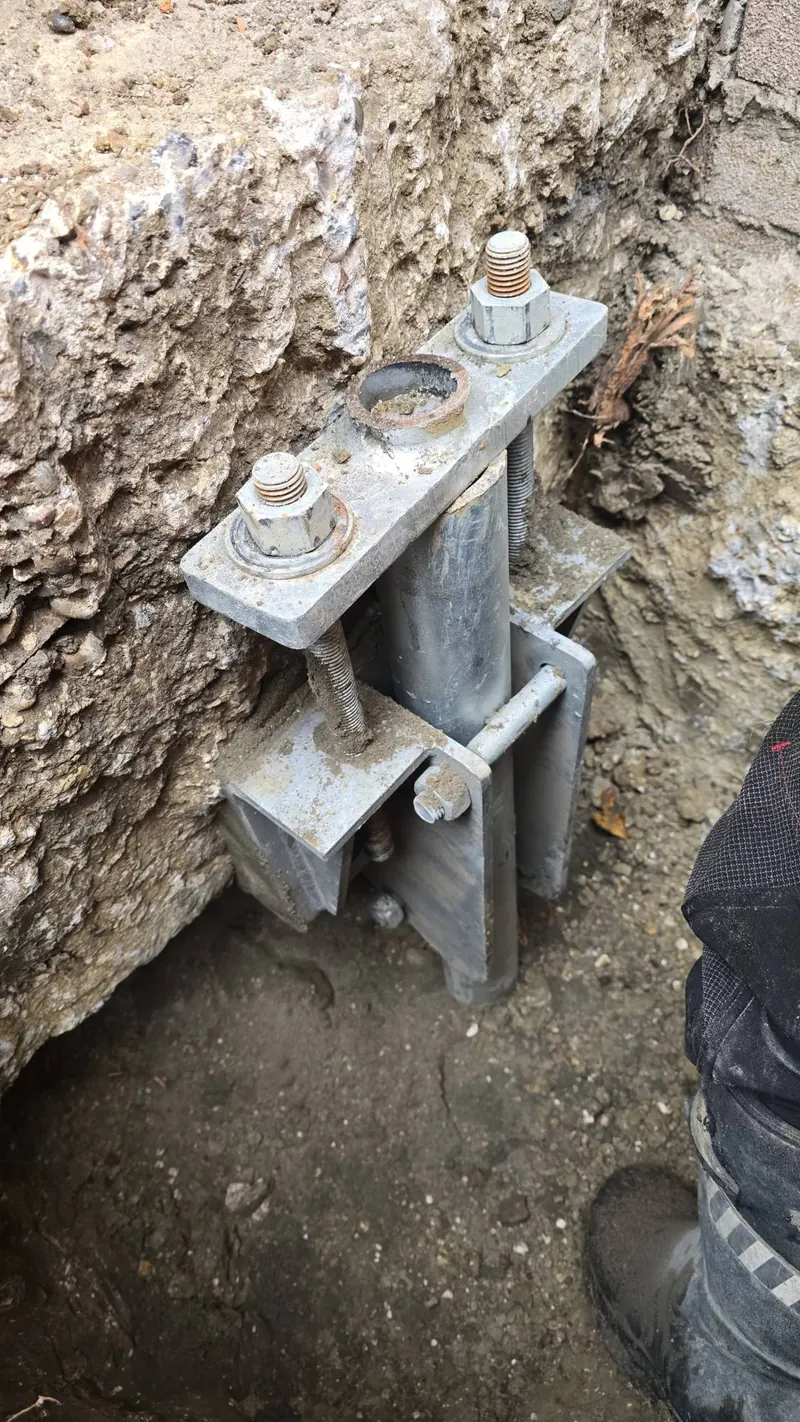
The underpinning bracket
The bracket sits beneath the existing footing and is connected to the head of the screw pile by threaded rods. Tightening them transfers the load of the wall onto the pile, which carries it down to firm ground below the soil that has been moving.
Our screw piles are built to the highest standards, to ISO 9001 and CE standards, and both the piles and the brackets are galvanised to protect them in the ground.
Why screw piles
Screw pile underpinning is used where traditional underpinning is not practical: where it would mean digging to great depths, for instance, or where the site will not take a piling rig.
Questions & answers
Every property is different, so call us to talk yours through.
0330 043 3216Usually, yes. A structural engineer or surveyor should confirm the cause and extent of the movement. We then design and install the underpinning from their report, and can work alongside them throughout.
Much less than traditional underpinning. Instead of a deep trench along the whole wall, only a small pit is needed at each pile position to reach the footing and fit the bracket.
Yes. As well as houses and extensions, we underpin conservatories, garages, retaining walls and boundary walls.
We offer nationwide coverage, with most of our work in London, the South East and East Anglia. See the areas we cover.
Request a quote
Send us your engineer's report, a few photos or the details, and we will come back to you with a price. We are open Monday to Saturday, 9am to 5.30pm.